Maintainer of this skill?
by avivgerz-hue
Make your vibe-coded app look less like AI slop. 72-rule UI design linter, WCAG + APCA contrast engine, 10 studio design presets, CLI & MCP server for React, Next.js & Tailwind.
# Add to your Claude Code skills
git clone https://github.com/avivgerz-hue/unslopGuides for using mcp servers skills like unslop.
See how unslop compares with popular alternatives.
unslop is an open-source mcp servers skill for AI coding assistants such as Claude Code, Codex CLI, and ChatGPT, built by avivgerz-hue. Make your vibe-coded app look less like AI slop. 72-rule UI design linter, WCAG + APCA contrast engine, 10 studio design presets, CLI & MCP server for React, Next.js & Tailwind. It has 62 GitHub stars.
unslop's catalog security scan is still queued. You can run an instant dependency and prompt-injection check now with the "Scan for vulnerabilities" button above.
Clone the repository with "git clone https://github.com/avivgerz-hue/unslop" and add it to your Claude Code skills directory (see the Installation section above). unslop ships a SKILL.md manifest, so compatible agents can discover and load it automatically.
unslop is primarily written in TypeScript. It is open-source under avivgerz-hue on GitHub, so you can review or fork the full source.
Yes. SkillsLLM lists many other MCP Servers skills you can browse and compare side by side. Open the MCP Servers category from the badge at the top of this page, or use the Related Skills and comparison links further down to weigh unslop against similar tools.
No comments yet. Be the first to share your thoughts!
Top skills in this category by stars
Available after the catalog security scan passes.
⚠️ Third-Party Software Notice
This skill is third-party open-source software developed and hosted independently on GitHub. SkillsLLM lists this project for discovery and does not control or maintain the underlying repository.
Any security checks, ratings, or warnings displayed by SkillsLLM are automated and limited in scope. They do not constitute a security certification or guarantee that the software is safe, error-free, or free from malicious code, vulnerabilities, compromised dependencies, or prompt-injection risks.
Review the source code, permissions, dependencies, and configuration before installing or running any third-party skill. Use is at your own risk. To the maximum extent permitted by applicable law, SkillsLLM is not liable for losses arising from third-party software.
The deep catalog scan for this skill is still queued. Run an instant dependency check now instead.
Act as a principal design engineer, not a visual suggestion generator. Preserve product behavior, content ownership, framework conventions, and accessibility while transforming generic AI output into a coherent software interface. Make every decision through composition, semantic tokens, readable typography, explicit interaction states, and measurable verification.
unslop_auditBaseline the current Design Craft Score and all seven pillars before touching components:
npx -y unslop-mcp audit . --json
When connected through MCP, call unslop_audit with the project path. Record:
file:line:column findings.| Pillar | Rule family | Diagnostic focus |
|---|---|---|
| Color & Contrast | SLOP-COLOR-* |
Generic gradients, harsh polarity, muddy text, hardcoded colors, exact WCAG AA/AAA, APCA-inspired perceptual contrast |
| Typography & Hierarchy | SLOP-TYPE-* |
Fluid display scales, reading measure, optical tracking and leading, tabular numeric UI, purposeful weight hierarchy |
| Layout & Rhythm | SLOP-LAYOUT-* |
Three-card clones, nested cards, off-grid spacing, excessive rounding, intentional grid and content edges |
| Surface & Elevation | SLOP-SURFACE-* |
Glass overuse, dark-mode shadow weight, decorative blobs, badge clutter, hairline elevation |
| Copy & Microcopy | SLOP-COPY-* |
AI marketing clichés, unsupported superlatives, emoji spam, vague benefits, missing product facts |
| Interaction & Motion | SLOP-UX-* |
Semantic controls, labels, keyboard rings, complete states, pointer targets, explicit transitions, reduced motion |
| Theme & Tokens | SLOP-TOKEN-* |
Dark parity, canvas-to-border elevation order, semantic names, token types, four/eight-pixel spacing |
Do not interpret a high score in one pillar as permission to ignore another. A visually restrained interface can still fail keyboard ergonomics, reading measure, or theme parity.
Choose one direction before editing components.
unslop_apply_presetUse unslop_apply_preset through MCP, or install through the CLI:
npx -y unslop-mcp init --preset linear-precision
npx -y unslop-mcp presets
npx -y unslop-mcp presets linear-precision
| Archetype | Direction |
|---|---|
swiss-editorial |
Warm paper, literary serif plus grotesk, exposed editorial grid, crisp rules |
linear-precision |
Obsidian surfaces, luminance hairlines, compact type, tabular operational precision |
stripe-atmospheric |
Cool slate atmosphere, crisp white elevation, cobalt trust, micro-shadow depth |
vercel-monochrome |
Architectural monochrome, geometric rhythm, minimal decoration, semantic status color |
teenage-engineering |
Industrial controls, technical labels, physical grid borders, international orange |
anthropic-warm-editorial |
Parchment and stone, literary headings, calm clay accents, generous reading measure |
bloomberg-terminal-dense |
High-density financial data, strict tabular alignment, explicit tickers, compact workflows |
raycast-command |
Frosted graphite command surfaces, keyboard-first selection, crisp shortcut badges |
fintech-institutional |
Forest-navy authority, auditable numeric hierarchy, restrained brass and emerald semantics |
neo-brutalist-craft |
Intentional ink borders, offset hard shadows, bold contrast, disciplined spacing |
Legacy v1 IDs remain loadable for existing projects, but new work should select a canonical v2 archetype.
unslop_extract_dnaExtract a reference instead of guessing its aesthetic:
npx -y unslop-mcp extract https://example.com --name reference --json -o design-dna.json
Review extraction warnings and compiled tokens. Never copy another product’s content, branding, or proprietary assets; extract only the design characteristics needed for the requested system.
Export the selected preset or extracted DNA in the required formats before touching component code:
npx -y unslop-mcp export-tokens --preset linear-precision --format tailwind-v4 --out tokens.css
npx -y unslop-mcp export-tokens --preset linear-precision --format tailwind-v3 --out tailwind.config.js
npx -y unslop-mcp export-tokens --preset linear-precision --format css --out tokens.css
npx -y unslop-mcp export-tokens --preset linear-precision --format w3c-json --out tokens.json
Use --source <url-or-css> --name <name> instead of --preset for extracted DNA. Confirm:
tabular-nums for data.unslop_refactor_planGenerate the Design Transformation Blueprint before performing the main refactor:
npx -y unslop-mcp refactor-plan . --preset linear-precision --report UNSLOP-REPORT.md
Through MCP, call unslop_refactor_plan with path, preset, and optional report. Read the complete blueprint:
Structural transformation rules:
max-w-prose (normally 65ch) or a deliberate token measure rather than full-width body copy.Use the project's semantic primitives and preserve real copy, data, links, handlers, DOM reading order, and accessible names. The examples use semantic tokens exported for the selected preset in the token foundation step; import that file first, or map these names to the equivalent existing semantic tokens. They are templates to adapt, not blind replacements or a reason to invent new content.
Before:
<section className="relative bg-gradient-to-r from-purple-500 to-indigo-500 text-center">
  <div aria-hidden="true" className="absolute blur-3xl opacity-30" />
  <h1 className="text-6xl">{title}</h1>
  <p>{description}</p>
</section>
After:
<section className="border border-[var(--border-subtle)] bg-[var(--surface-1)] px-6 py-12 text-[var(--text-primary)]">
  <h1 className="max-w-[20ch] text-4xl font-semibold leading-tight tracking-[var(--tracking-display)] md:text-5xl">{title}</h1>
  <p className="mt-4 max-w-prose leading-relaxed text-[var(--text-primary)]">{description}</p>
</section>
Remove the decorative blob element, not merely its blur; preserve any meaningful content or interaction separately. Remove gradient text utilities such as bg-clip-text text-transparent from the heading so text remains visible. The border utility is a 1px hairline using the chosen theme's luminance border token. Do not assume the token contrast is compliant until measured.
Before:
<div className="grid grid-cols-1 gap-6 text-center md:grid-cols-3">
  <article><IconA /><h2>{firstTitle}</h2><p>{firstDetail}</p></article>
  <article><IconB /><h2>{secondTitle}</h2><p>{secondDetail}</p></article>
  <article><IconC /><h2>{thirdTitle}</h2><p>{thirdDetail}</p></article>
</div>
After, for unequal feature importance:
<div className="grid grid-cols-1 gap-6 md:grid-cols-12">
  <article className="border border-[var(--border-subtle)] bg-[var(--surface-1)] p-6 text-left md:col-span-7"><IconA /><h2>{firstTitle}</h2><p className="max-w-prose">{firstDetail}</p></article>
  <article className="border border-[var(--border-subtle)] bg-[var(--surface-1)] p-6 text-left md:col-span-5"><IconB /><h2>{secondTitle}</h2><p className="max-w-prose">{secondDetail}</p></article>
  <article className="border-t border-[var(--border-subtle)] pt-6 text-left md:col-span-12"><IconC /><h2>{thirdTitle}</h2><p className="max-w-prose">{thirdDetail}</p></article>
</div>
Retain all three items and their source order on mobile and desktop. Choose a semantic <table> with caption and column/row headers for comparable values, or a responsive split screen for explanatory copy alongside a real product preview. Use the bento layout only when the content supports unequal emphasis; do not fabricate a product preview or comparison data.
Before: <p className="w-full">{body}</p> and <span>{price}</span>.
After: <p className="max-w-prose leading-relaxed">{body}</p> and <span className="tabular-nums">{price}</span>. Apply tabular-nums to every metric, price, counter, and comparable numeric column; right-align columns where comparison benefits. Tailwind's default max-w-prose is 65ch: ensure the project's configured value is 60ch–70ch, or use max-w-[65ch] when it has been overridden.
For each theme, check every foreground/background pair (including muted text, links, focus indicators and alpha-composited surfaces) against the actual rendered background. WCAG AA requires at least 4.5:1 for normal text and 3:1 for large text; AAA requires 7:1 for normal text and 4.5:1 for large text. Large text is at least 24px regular or 18.66px bold. Essential non-text UI and focus indicators need at least 3:1 against adjacent colors. Adjust the semantic token values for each theme until the applicable target is met; never assert that a preset or class alone guarantees AA/AAA. Recheck keyboard focus, content order, responsive stacking, and both themes after transformation.
Apply polish only after structure and tokens are coherent.
blur-3xl opacity-30 blobs.1px low-alpha borders over heavy ambient shadows.clamp() or responsive stops; protect intentional line breaks.tabular-nums to prices, metrics, counters, timestamps, identifiers, and data tables; right-align comparable values.Finish every control and state, then repeat the diagnostic loop:
npx -y unslop-mcp audit . --fail-under 95
npx -y unslop-mcp refactor-plan . --preset linear-precision --report UNSLOP-REPORT.md
Required interaction review:
<button>, <a>, <input>, and <select> semantics instead of clickable <div> elements.:focus-visible rings with adequate offset in both themes.transition-all with explicit transition-colors, transition-transform, or transition-opacity, plus motion-reduce:transition-none or equivalent behavior.tabindex. Provide practical pointer targets and keyboard alternatives.The task is complete only when:
unslop_audit reports 95–100/100 (Grade A+) with no suppressed findings.UNSLOP-REPORT.md translations and P0/P1 steps have been applied or explicitly resolved.npx -y unslop-mcp --version
npx -y unslop-mcp audit .
npx -y unslop-mcp refactor-plan . --report UNSLOP-REPORT.md
npx -y unslop-mcp init --preset swiss-editorial
npx -y unslop-mcp extract ./tokens.css --name extracted -o .claude/skills/unslop/SKILL.md
npx -y unslop-mcp export-tokens --preset swiss-editorial --format w3c-json --out tokens.json
npx -y unslop-mcp --mcp
MCP tools:
unslop_audit — 72-rule diagnostic and seven-pillar scorecard.unslop_extract_dna — reference extraction and compiled Design DNA.unslop_apply_preset — archetype installation and merge-safe MCP configuration.unslop_refactor_plan — exact Design Transformation Blueprint and prioritized refactor plan.GitHub execution remains available as an alternative to the npm package:
npx -y github:avivgerz-hue/unslop audit .
npx -y github:avivgerz-hue/unslop --mcp
⭐ If this tool helps your AI coding workflow, please give this repository a Star! It helps more developers discover the project.
VibeFoundry Agent Suite: 🎨 unslop — UI Design DNA & Anti-Slop Engine (npx -y unslop-mcp@latest init) · 🛡️ vibe-shield — Security Scanner for AI Code (npx -y @vibefoundry/vibe-shield@latest scan .) · 👻 ghost-qa — Autonomous Headless Browser QA (npx -y ghost-qa@latest test http://localhost:3000)




npx -y unslop-mcp@latest init
Your agent can write the code. unslop gives it a measurable design engineering protocol.

unslop is a zero-runtime-dependency UI/UX Design Engineering CLI, native MCP Server, and AI Agent Skill. It audits 72 rules across seven design craft pillars, installs ten studio-grade archetypes, extracts Design DNA, exports four token formats, and turns every finding into an exact, prioritized transformation blueprint for JSX/TSX, HTML, Vue, Svelte, CSS, and Tailwind codebases.
Works natively with Claude Code, OpenCode, OpenAI Codex, Cursor, Windsurf, GitHub Copilot, Cline/Roo Code, Zed, and universal Agent Skills.
Human-readable CLI audits and refactor plans include a copyable badge for the calculated grade and a GitHub star link. Commands that do not calculate a score show a clearly labeled example badge. JSON and MCP stdio are never decorated.
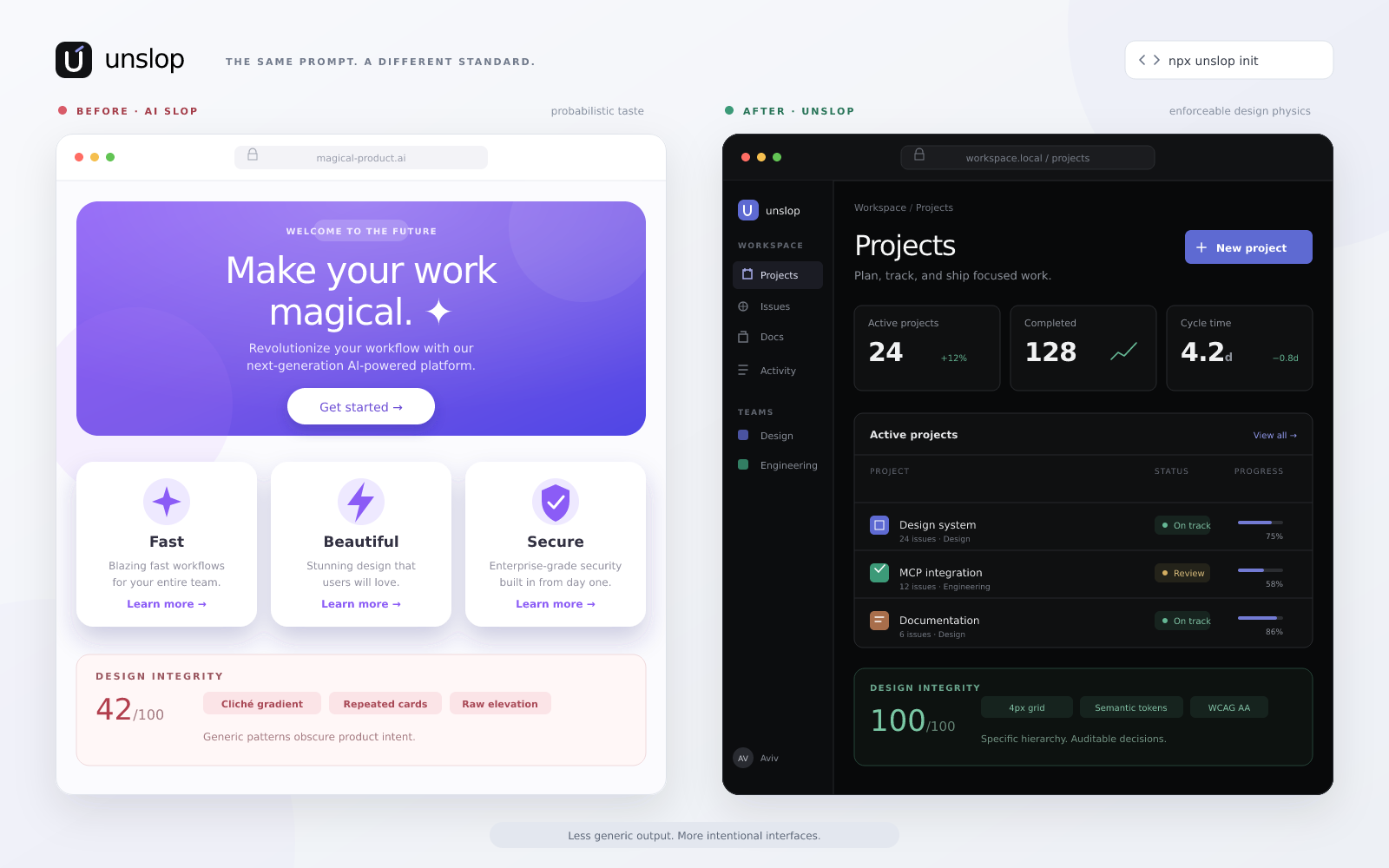
npx -y unslop-mcp init --preset linear-precision
npx -y unslop-mcp audit .
npx -y unslop-mcp refactor-plan . --report UNSLOP-REPORT.md
Install the latest universal integrations directly from GitHub in any project (the published npm version may lag behind main):
npx -y github:avivgerz-hue/unslop#main init --preset linear-precision
| Agent | Native files generated by unslop init |
|---|---|
| Claude Code | .mcp.json, CLAUDE.md, .claude/skills/unslop/SKILL.md, .claude-plugin/plugin.json |
| OpenCode | opencode.json with mcp.unslop-mcp, plus AGENTS.md |
| OpenAI Codex CLI / Universal Agents | AGENTS.md and .agents/skills/unslop/SKILL.md |
| Cursor | .cursor/mcp.json, .cursor/rules/unslop.mdc, and legacy .cursorrules |
| Windsurf | .windsurfrules |
| VS Code / GitHub Copilot | .vscode/mcp.json and .github/copilot-instructions.md |
| Cline / Roo Code | .clinerules |
| Zed | .zed/settings.json under context_servers |
Restart or reload the agent after installation so it discovers the new MCP server and Skill. Existing instructions outside Unslop's managed block, unrelated MCP servers, settings, inputs, and custom fields are preserved. Running init again is byte-for-byte idempotent.
This repository itself includes root AGENTS.md, CLAUDE.md, opencode.json, .claude-plugin/plugin.json, and both Claude/Codex Skill paths for immediate auto-discovery.
The result is not a generic prompt. It is a versioned token contract, a Design Craft Score from 0–100, a seven-pillar scorecard, exact before/after translations, and file-level steps your agent can execute in one coherent pass.
| Capability | v2 contract |
|---|---|
| Design Craft Engine | 72 rules · 7 pillars · A+–F grades |
| Color analysis | Exact WCAG 2.1 AA/AAA plus APCA-inspired perceptual checks |
| Studio archetypes | 10 complete production design systems; five v1 IDs remain compatible |
| Token formats | Tailwind v4 @theme, Tailwind v3 config, CSS custom properties, W3C Design Tokens JSON |
| Transformation | refactor-plan CLI and unslop_refactor_plan MCP tool generate UNSLOP-REPORT.md |
| Agent protocol | Five-step principal UI/UX design engineer SKILL.md |
| Runtime | Node.js 20.19+, JSON-RPC 2.0 stdio, zero runtime dependencies |
Run a deterministic baseline before letting an agent rewrite the interface:
npx -y unslop-mcp audit . --json
Design Craft Score: 78/100 (C)
7-Pillar Scorecard:
  Color & Contrast: 82/100 (B) · 3 findings
  Typography & Hierarchy: 76/100 (C) · 4 findings
  Layout & Spatial Rhythm: 70/100 (C) · 5 findings
  Surface & Elevation: 88/100 (B) · 2 findings
  Copy & Microcopy: 82/100 (B) · 3 findings
  Interaction & Motion: 58/100 (F) · 7 findings
  Theme & Token Architecture: 90/100 (A) · 2 findings
| Pillar | Canonical rules | What the engine detects |
|---|---|---|
| 1 · Color, Atmospheric Polarity & Contrast Math | SLOP-COLOR-* |
Purple/pink/indigo clone gradients, neon glows, absolute black/white glare, muddy grays, hardcoded component colors, low-opacity text, exact WCAG AA/AAA, APCA-inspired polarity |
| 2 · Typography & Scannable Hierarchy | SLOP-TYPE-* |
Fixed display scales, monotonous heading weights, paragraphs beyond readable measure, missing tabular-nums, cramped body leading, loose display leading, untracked uppercase labels |
| 3 · Layout, Spatial Rhythm & Grid Craft | SLOP-LAYOUT-* |
Centered three-card clones, nested cards, off-grid arbitrary values, excessive container rounding, arbitrary grids, missing content measures, conflicting spacing and radii |
| 4 · Visual Restraint & Surface Elevation | SLOP-SURFACE-* |
Glassmorphism overuse, heavy dark-mode shadows, decorative blur blobs, icon badge clutter, unanchored raw elevation, ad-hoc shadow stacks |
| 5 · Copywriting & Microcopy Anti-Slop | SLOP-COPY-* |
100+ cliché variants, including “Unleash the power,” “Revolutionize,” “Supercharge your workflow,” “Seamless integration,” “Next-generation,” hype, filler, superlatives, and emoji spam |
| 6 · Interactive Ergonomics, Motion & States | SLOP-UX-* |
Clickable divs, missing labels and keyboard rings, incomplete hover/active/disabled states, small targets, positive tabindex, transition-all, missing reduced-motion behavior |
| 7 · Theme Parity & Token Architecture | SLOP-TOKEN-* |
Broken Canvas → Surface-1 → Surface-2 → Interactive → Border order, asymmetric dark overrides, missing dark companions, off-grid or mistyped tokens |
Legacy slop/* IDs remain in output for compatibility. Canonical SLOP-* findings drive the v2 seven-pillar score, with location-level deduplication so compatibility output does not double-penalize a finding.
Every audit includes exact file:line:column diagnostics and refactoring instructions. The overall score is the rounded mean of seven independently capped pillar scores; 95–100 is A+. Use --fail-under in CI or agent loops:
npx -y unslop-mcp audit . --fail-under 95
npx -y unslop-mcp audit . --prompt
npx -y unslop-mcp audit src --json --no-fail
Static analysis never replaces rendered verification. Keyboard operation, responsive behavior, actual contrast, content overflow, and reduced motion still need explicit inspection.
unslop_refactor_plan turns the audit into an executable Design Transformation Blueprint instead of a list of vague taste suggestions:
npx -y unslop-mcp refactor-plan . --preset linear-precision --report UNSLOP-REPORT.md
The report contains:
Example translations:
| Before | After |
|---|---|
from-purple-500 via-pink-500 to-indigo-500 |
bg-[var(--surface-1)] text-[var(--text-primary)] |
shadow-xl |
border border-[var(--border-subtle)] shadow-[var(--shadow-md)] |
p-[13px] |
p-[var(--spacing-12)] |
rounded-3xl |
rounded-[var(--radius-lg)] |
transition-all |
transition-colors motion-reduce:transition-none |
#777777 |
var(--text-primary) |
| “Unleash the power” | A concrete product capability and verifiable user outcome |
Use --json for the complete machine-readable blueprint:
npx -y unslop-mcp refactor-plan src --preset swiss-editorial --report reports/DESIGN.md --json
Inspect and install a complete token and agent-rule contract:
npx -y unslop-mcp presets
npx -y unslop-mcp presets anthropic-warm-editorial
npx -y unslop-mcp init --preset anthropic-warm-editorial
| Archetype | Visual and engineering thesis |
|---|---|
swiss-editorial |
High-contrast editorial grid, warm paper, serif/grotesk pairing, crisp hairline rules |
linear-precision |
Obsidian craft, luminance borders, compact tracking, subtle layers, tabular precision |
stripe-atmospheric |
Refined slate atmosphere, crisp white surfaces, cobalt trust, layered micro-shadows |
