Captain Claw
Command a fleet of AI agents




Most AI tools give you one agent in a chat box. Captain Claw Flight Deck is a multi-agent command center — spawn specialist teams, run six orchestration modes, ship software with Code (a plan → build → independent-review pipeline), and compose deterministic Flows. Self-hosted, MIT licensed, and works with every major LLM provider (or 100% local with Ollama).
🌐 Website · 🚀 Live Demo · 📖 Docs · 📦 PyPI

A self-hosted framework for orchestrating fleets of specialist AI agents — from ensemble reasoning (six orchestration modes) to a full agentic coding pipeline (plan → independent review → ship). Model-agnostic and local-friendly: connect OpenAI, Anthropic, Google Gemini, DeepSeek, Ollama, or OpenRouter (plus "Sign in with ChatGPT" — no API key), or run 100% local with Ollama. Backed by 48 built-in tools per agent, persistent cross-session memory, and autonomous "dream cycle" cognition.
💻 NEW: Code — an engineering department, not a coding assistant
Describe what you want built. A router sizes the job; big work runs plan → your approval → build → three independent reviewers in parallel → triage → capped fix loop, every phase a git commit in the folder's own repo. Agents query a persistent Code Map (symbols + architecture, git-hash-fresh) instead of re-reading your tree; per-turn token costs are shown in chat; the whole process exports as one auditable Markdown transcript. Works on fresh folders or your existing local repos linked in — on any models you configure, including a cheap implementer with a premium reviewer.
Cursor and Claude Code give you one very good agent that plans, writes, reviews, and tests in a single context. Code splits those roles across independent agents — the reviewer never grades its own homework, QA actually runs the tests — and puts you at the approval gate before anything is built. Self-hosted, model-agnostic, no lock-in. A complete real run (an RTS game with 185 tests, ~$2.50 on DeepSeek) ships in examples/code/. Details in RELEASE_NOTES_0.7.0.md and USAGE.md.
Pick the right shape for the problem
One agent isn't always the answer — and one orchestration strategy never is. Captain Claw ships six distinct modes, each tuned to a different kind of work.
| 🛠️ Agent Forge — describe a goal, an LLM designs the whole team (roles, models, tools, SOPs) | 🏛️ Agent Council — specialists deliberate across moderated rounds, then vote and synthesize |
 |
 |
| 🔀 Basna — N agents answer the same question blind, merged by reliability into one high-confidence result | 🤝 Vatra — a team collaborates on a shared blackboard, each owning sections, improving over review rounds |
 |
 |
The fifth mode is 💻 Code (above) — a plan-gated, independently-reviewed engineering pipeline. The sixth is Flight Deck itself — spawn, monitor, and coordinate the whole crew from one dashboard.
More than orchestration
⚙️ Flows — a deterministic automation DSL (triggers, gosub, parallel spawn/join, on error), validated by a parser, not interpreted by an LLM |
🔭 Observatory — it keeps thinking when you're away: a live, auditable stream of thoughts, dreams, and standing intentions |
 |
 |
- Plan Mode & Deep Mode — for when "probably right" isn't good enough: a reviewable DAG of verified steps, and frontier-quality answers via multiple rollouts + self-consistency voting + diverse-lens critics.
- 6-layer shared memory — working, semantic (vector + BM25), deep (full-text), insights, autonomous nervous system, and self-reflection — carried across sessions and across every agent.
- Shared Virtual File System — a host-sandboxed, per-user workspace the whole fleet reads and writes, with per-file authorship.
- 31 ready-made specialists — an editable archetype library spanning research, writing, engineering (a full coding family: planners, implementers, debugger, reviewers, QA, git operator, cartographer), data, ops, finance, and multimedia.
See it in action

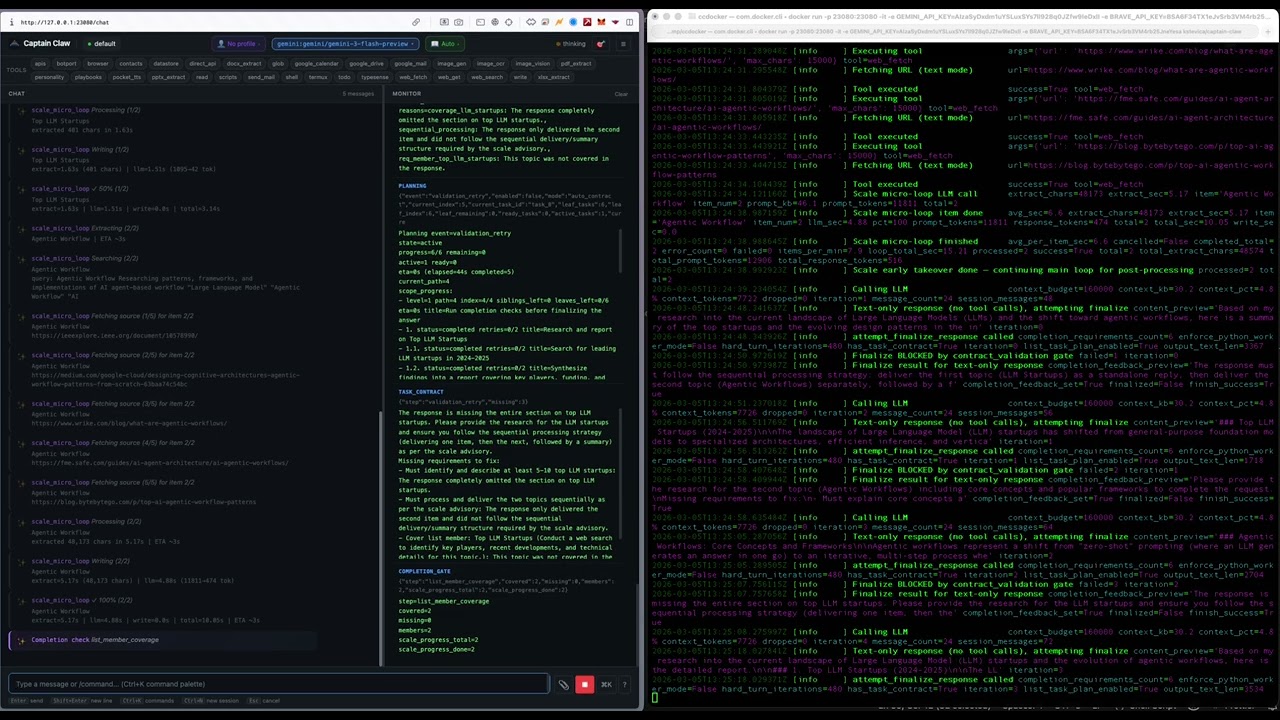
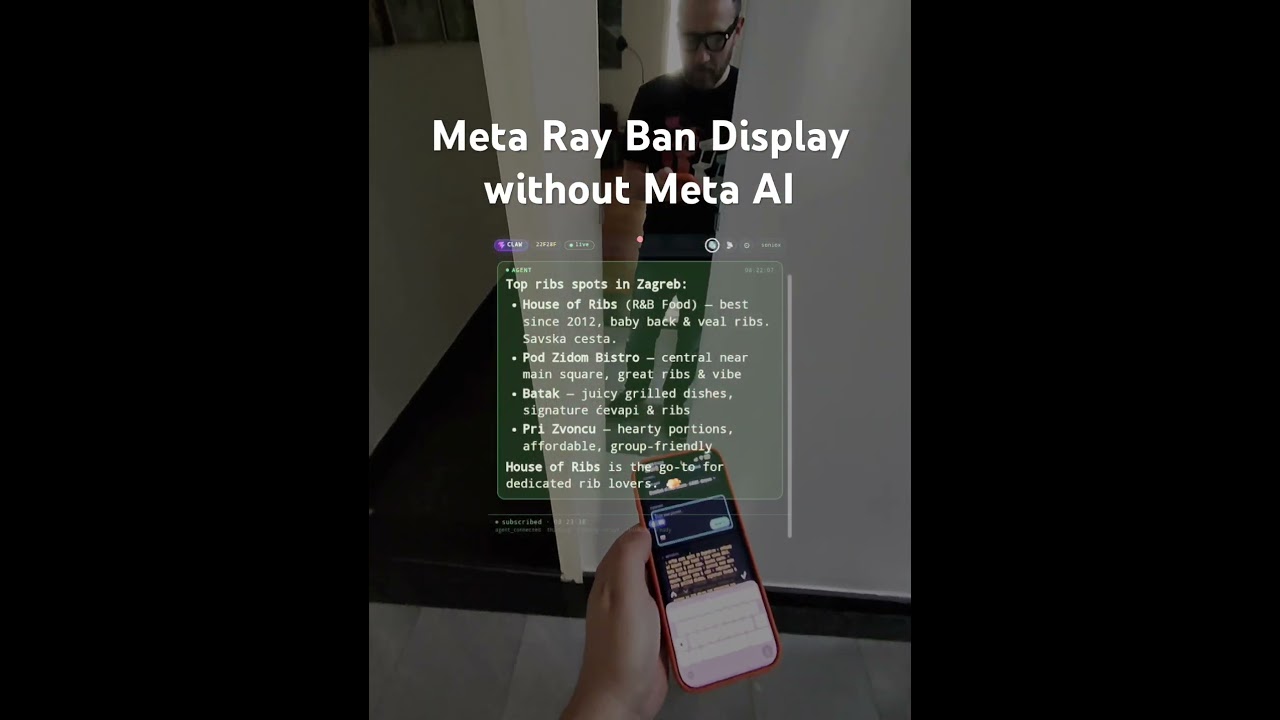
⭐ Star the repo
Captain Claw is MIT licensed and free forever — your data stays on your machine, bring your own keys or run 100% local with Ollama. It's built solo and growing fast, and every star helps another builder discover it. If it looks useful, would you give it a star?
What's New in 0.7.8
Lanes, queues that finish · Iskre shape their world. Long work that runs unattended: one agent gains three parallel lanes, the task queue stops stranding itself and learns to plan its own batches, and the datastore tool stops turning one fumbled argument into thirty tool calls of hunting. Everything opt-in — lane A is the agent you already have.
- Lanes A/B/C — three rooms on one agent process, each with its own session, transcript, queue and busy flag, running at the same time. Three id ranges enrich in parallel against the same table. An omitted lane resolves to A, so WhatsApp, cron, botport and every existing client are untouched. A tab strip shows each lane's state and marks the one that produced output while you looked away.
- A queue that finishes — four ways it could stall are closed: a slash command that answered out of band, a trailing question read as "waiting for you", a give-up reply ticked off as success (it now re-runs the task — verbatim, then nudged to how it failed — and after three tries stops rather than skipping), and lanes silently opening in MANUAL. Each card reports what its run cost: times, elapsed, tools, tokens.
- The Task Planner — describe a repetitive job once, attach files, get a plan you read and edit before anything is queued. The model returns one template plus a range, never the messages, so every task is byte-identical except its range and no rule can drift between batch 3 and batch 19. Ranges come from the table's real MIN/MAX. Continue where the last sitting stopped, free.
- The datastore tool answers a fumbled call — a dropped
tablerecovers or refuses with a filled-in retry, synonyms (data,select,order, …) are renamed instead of silently ignored, a SQL write comes back translated, and every way a model asks for a range now works. One repeatedwherekey used to widen a 10-row read into 1.38M characters of context. - Iskre shape their world — beings craft and place objects, name their homes, break ground on impulse (a new Impulse genome stat), and hand work between their two brains on a visible work board. The keeper paints roads, grows the plot, and builds anywhere from the map or in first person.
What's New in 0.7.6
Iskra — living beings you raise. A new Beings page introduces persistent digital beings with a genome, a token wallet, drives, and a life loop that ticks on its own heartbeat — you parent them through real developmental stages (infant → child → adolescent → adult). Additive and self-contained (a new beings.db auto-creates; needs a Flight Deck restart).
- A being that lives — conceive one with a point-buy genome (40 points across 7 attributes; presets or a roll), a daily-allowance token wallet conserved by construction (family-mint-only; zero balance halts cogn