DBPilot
Self-hosted database autonomous diagnostics platform.





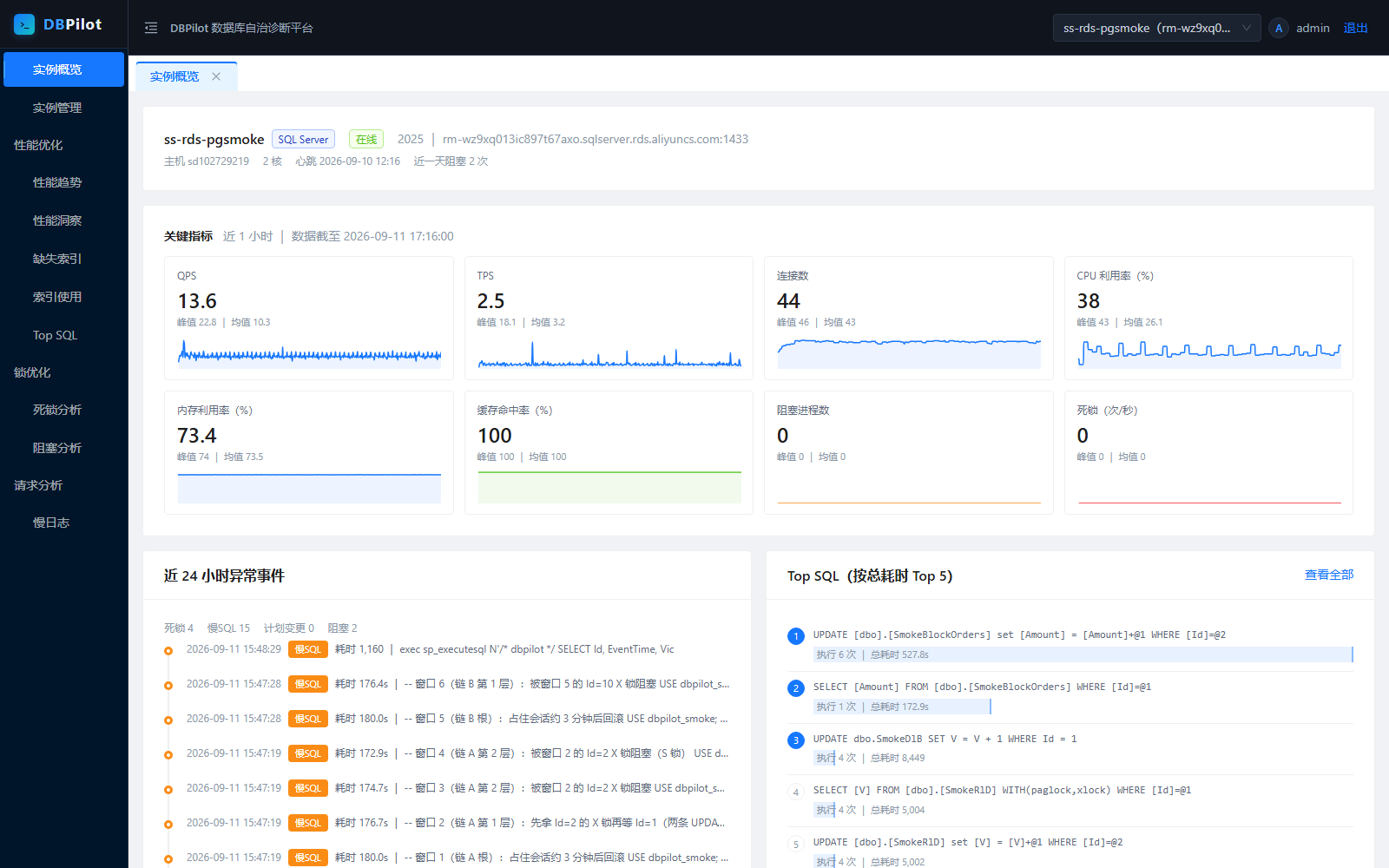
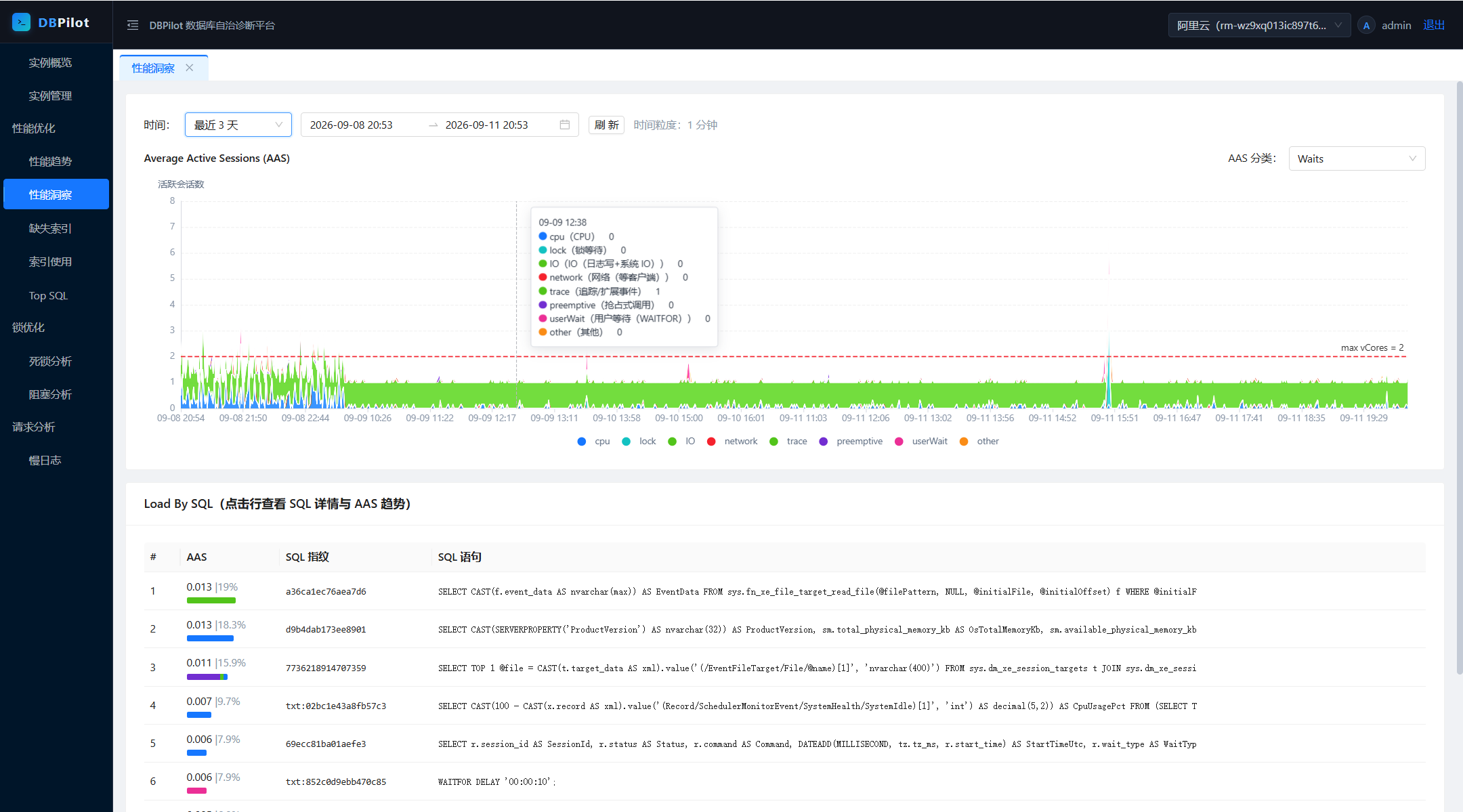
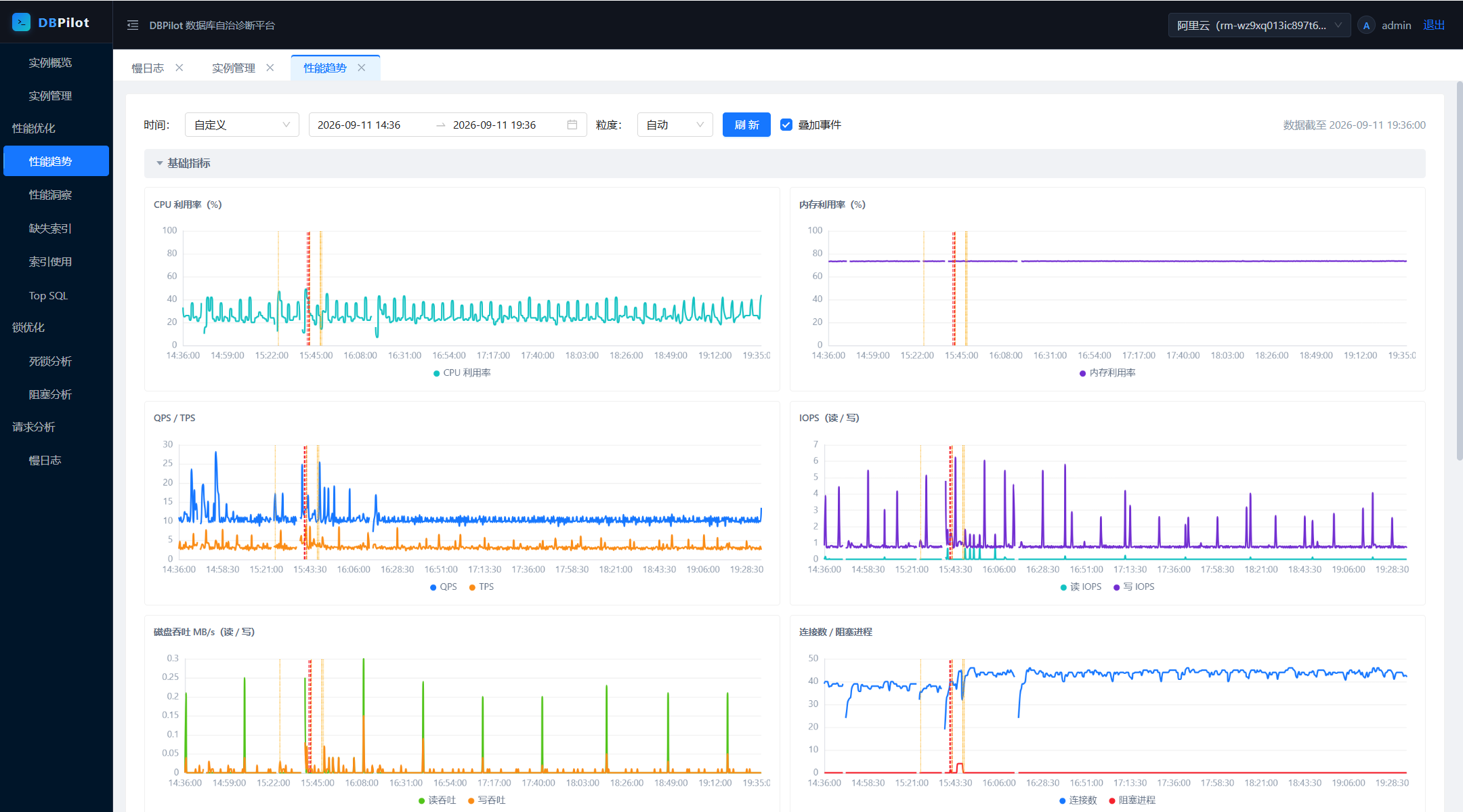
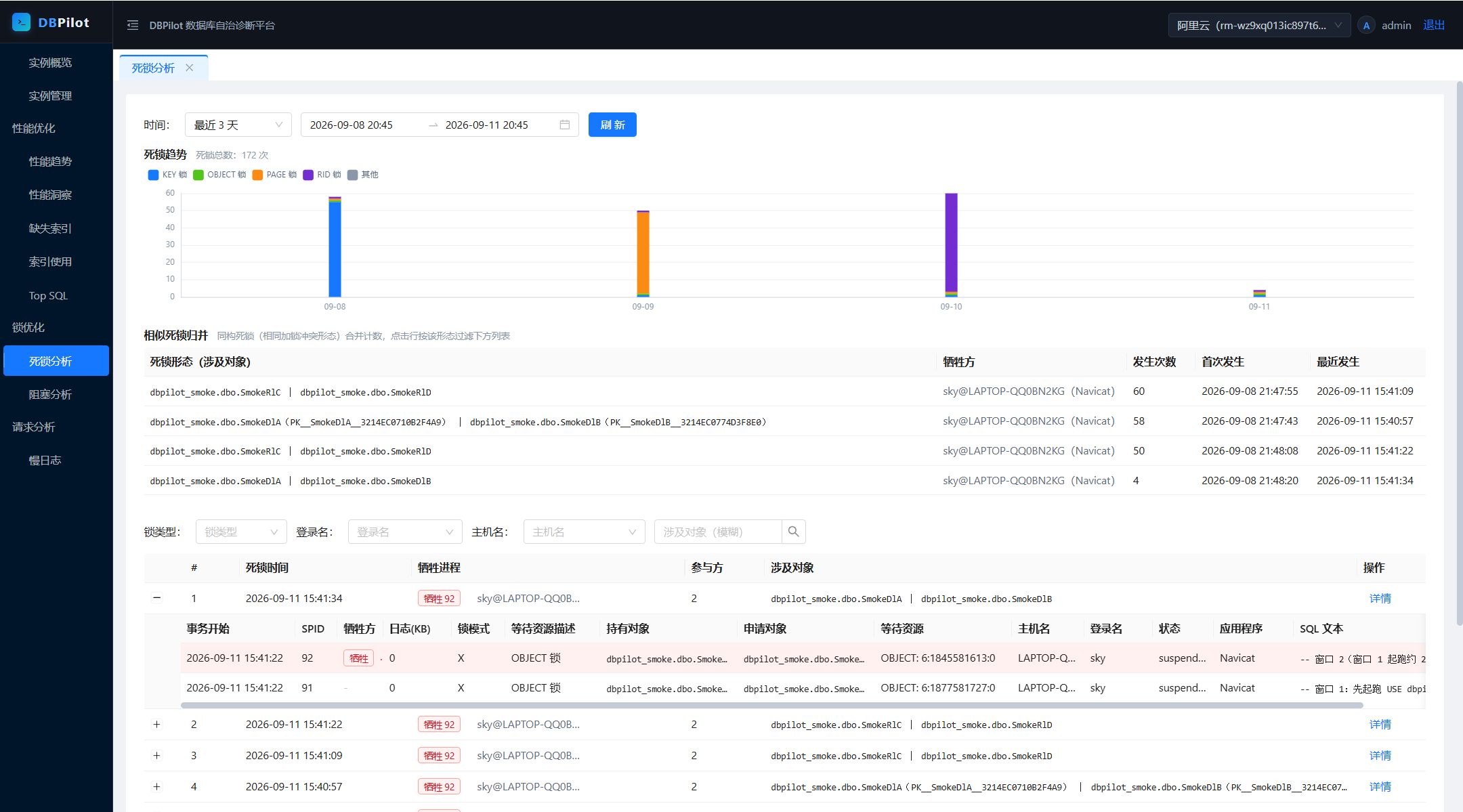
DBPilot continuously samples your instances and serves the day-to-day DBA workflow in one web console: performance trends and insight (AAS load decomposition), Top SQL, query plan change tracking, missing-index advice, index usage & fragmentation, blocking analysis, deadlock analysis, and slow query logs.
Contents
- Highlights
- Screenshots
- Quick start
- Password and master key
- Configuration
- Building from source
- Architecture
- Features
- Engine support matrix
- AI diagnostics (MCP Server)
- Overhead on monitored instances
- Embedding via NuGet
- FAQ
- License
Highlights
- Single-process deployment — one .NET 10 process + one metadata DB, schema auto-created on startup (SQL Server / MySQL / PostgreSQL / SQLite).
- Monitors three engines — SQL Server 2008–2022, MySQL 8.0+, PostgreSQL 13+. Monitoring and metadata-store engines are independent axes: any combination works.
- <1% CPU overhead — collectors read only in-memory metadata views (DMVs /
pg_stat_*/performance_schema); business tables are never scanned. - AI-ready — built-in read-only MCP Server exposes 11 diagnostic tools to AI agents (Claude Code, Codex CLI). Just ask: "did any SQL slow down in the last hour?"
- Capability-driven UI — features without an equivalent data source hide or degrade per engine (PostgreSQL gets deadlock trends instead of event details); APIs answer with actionable messages.
Screenshots
| Performance insight (AAS) | Performance trends |
|---|---|
 |
 |
| Deadlock analysis | Deadlock event detail |
|---|---|
 |
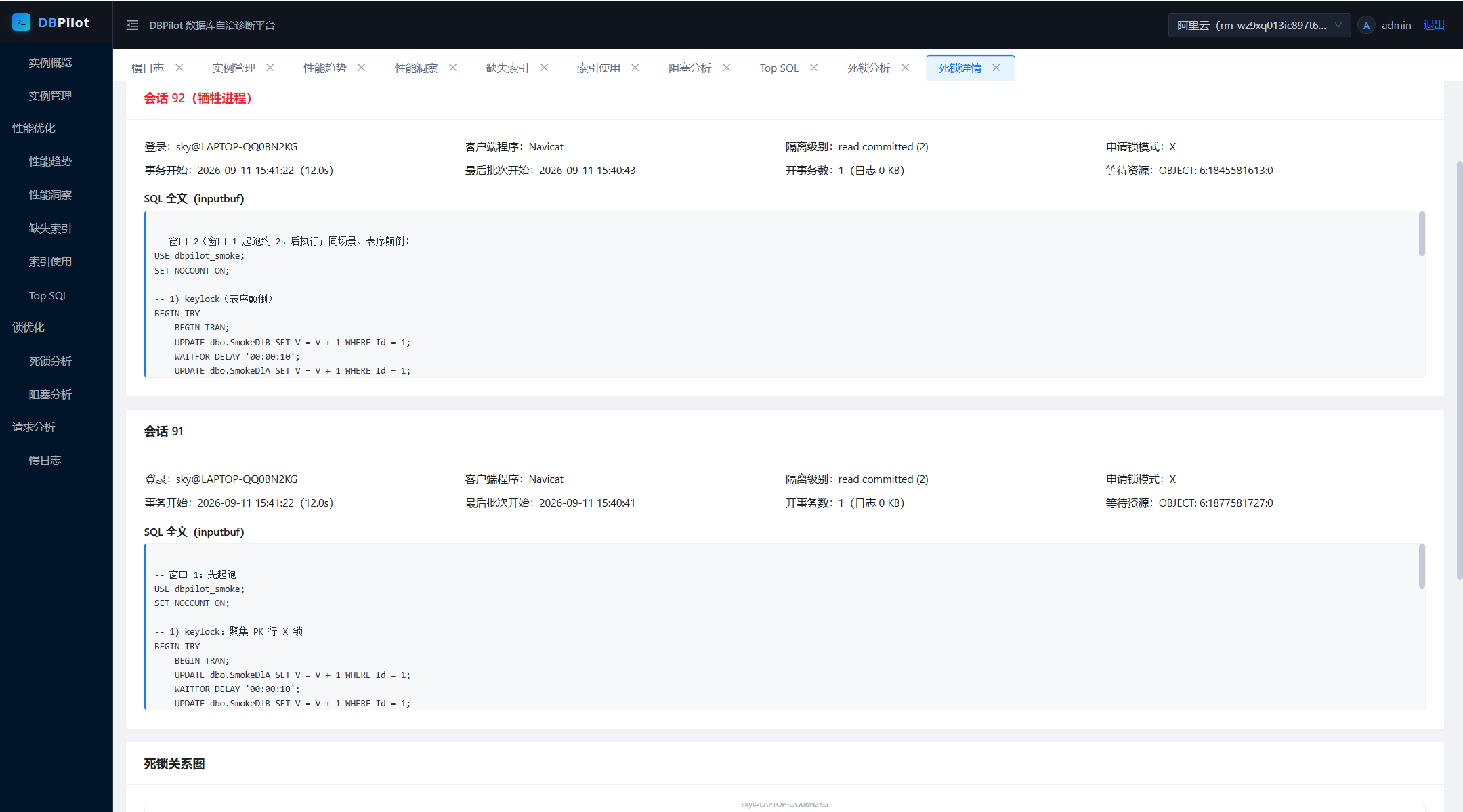 |
| Blocking analysis | Blocking chain detail |
|---|---|
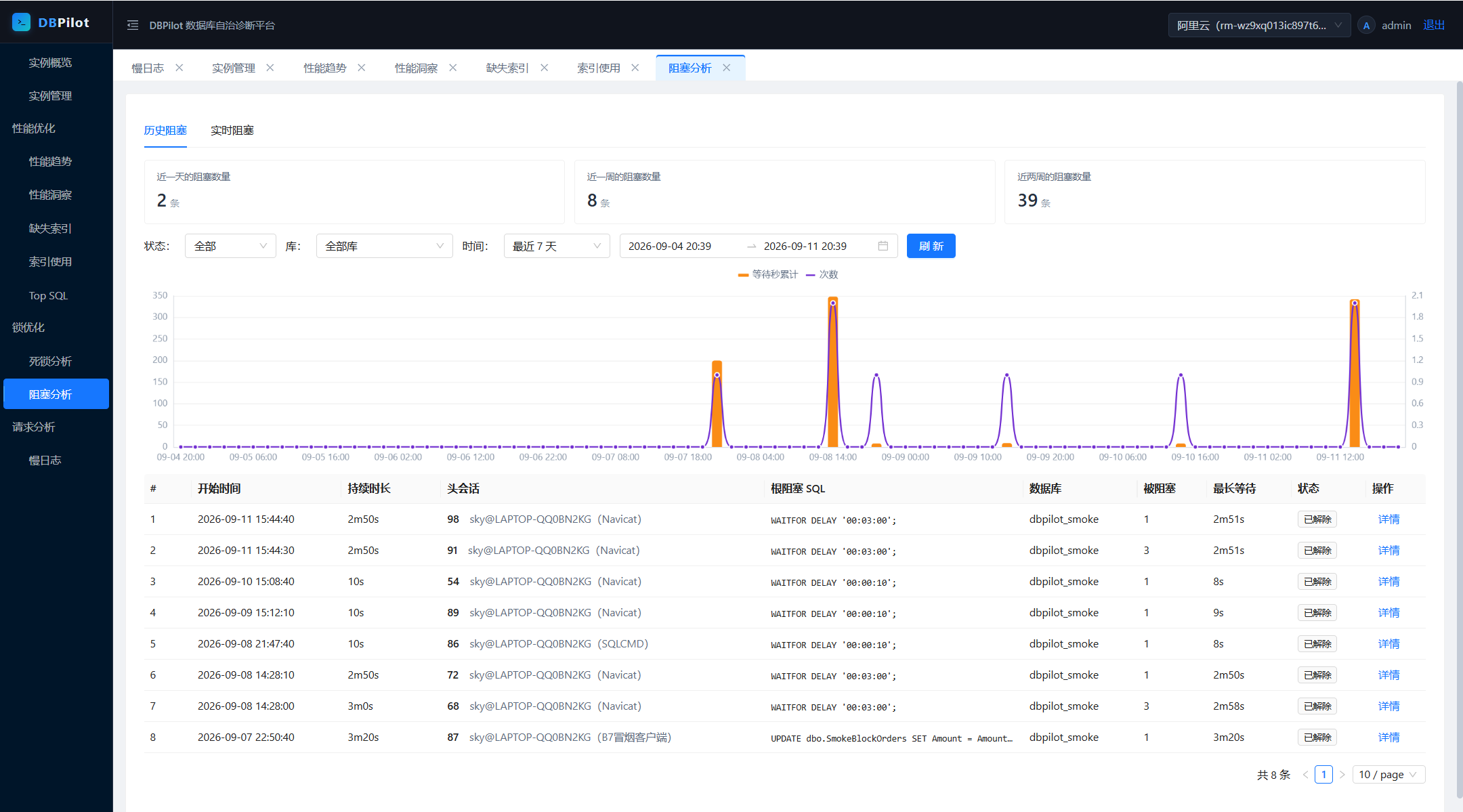 |
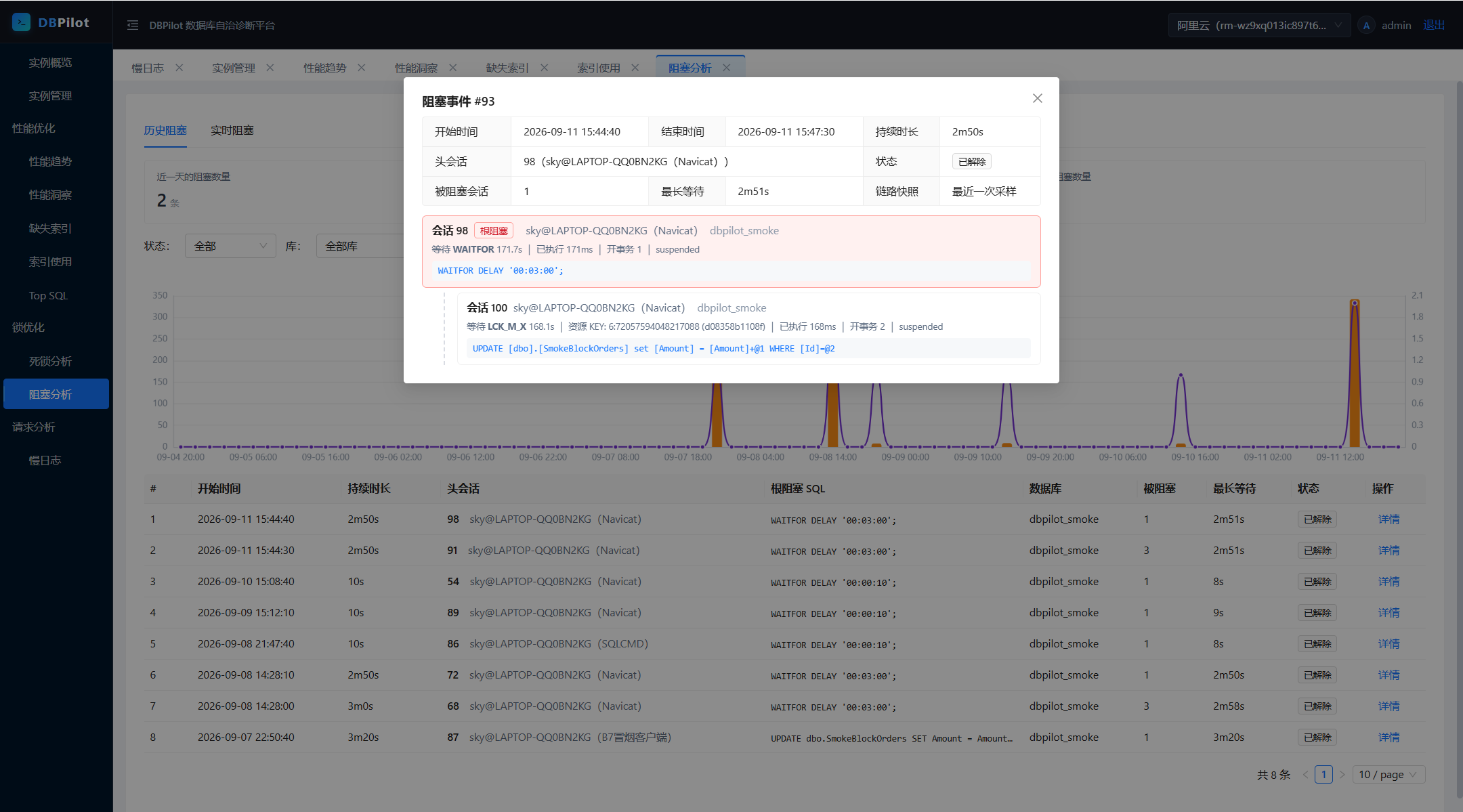 |
| Index usage | Slow query log |
|---|---|
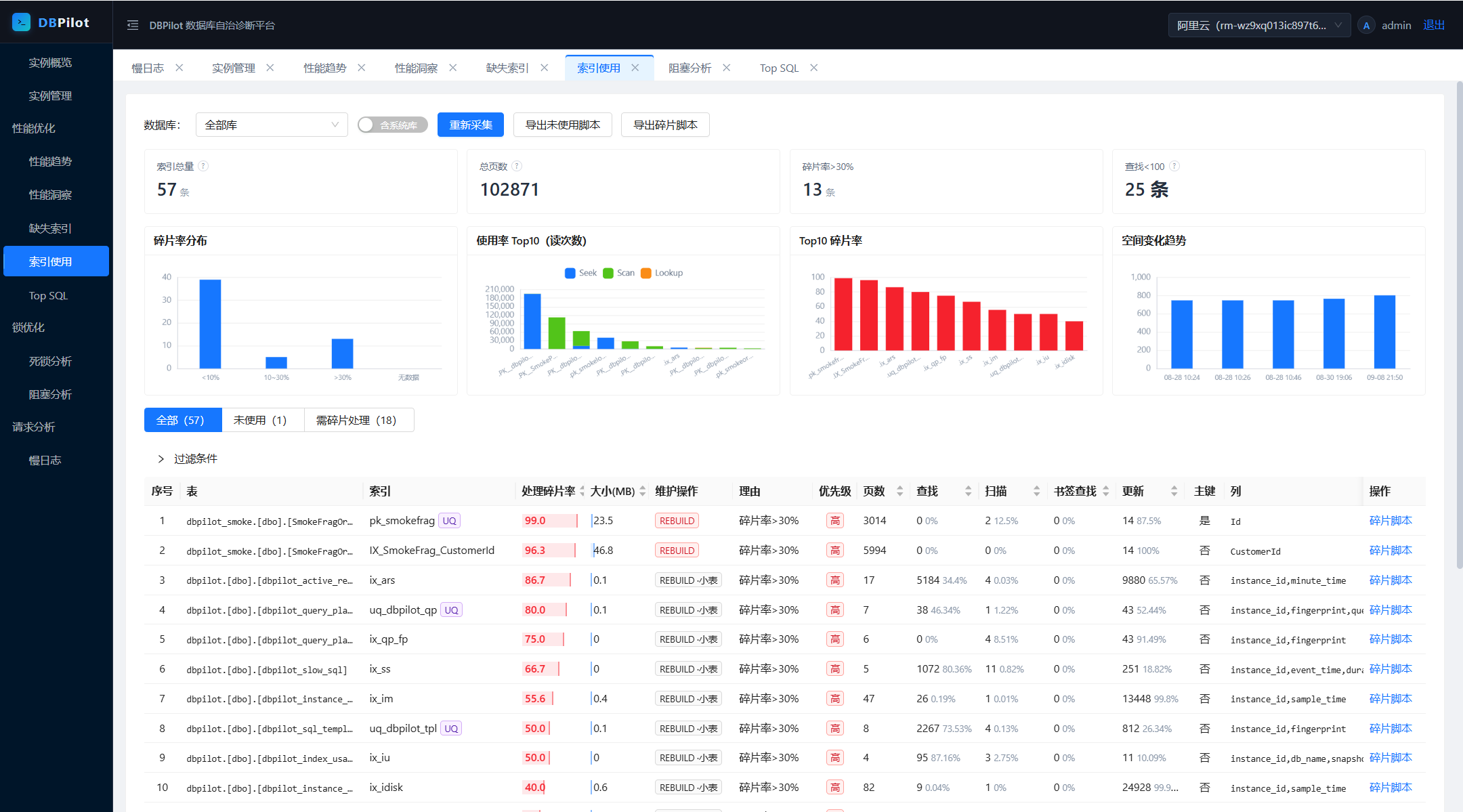 |
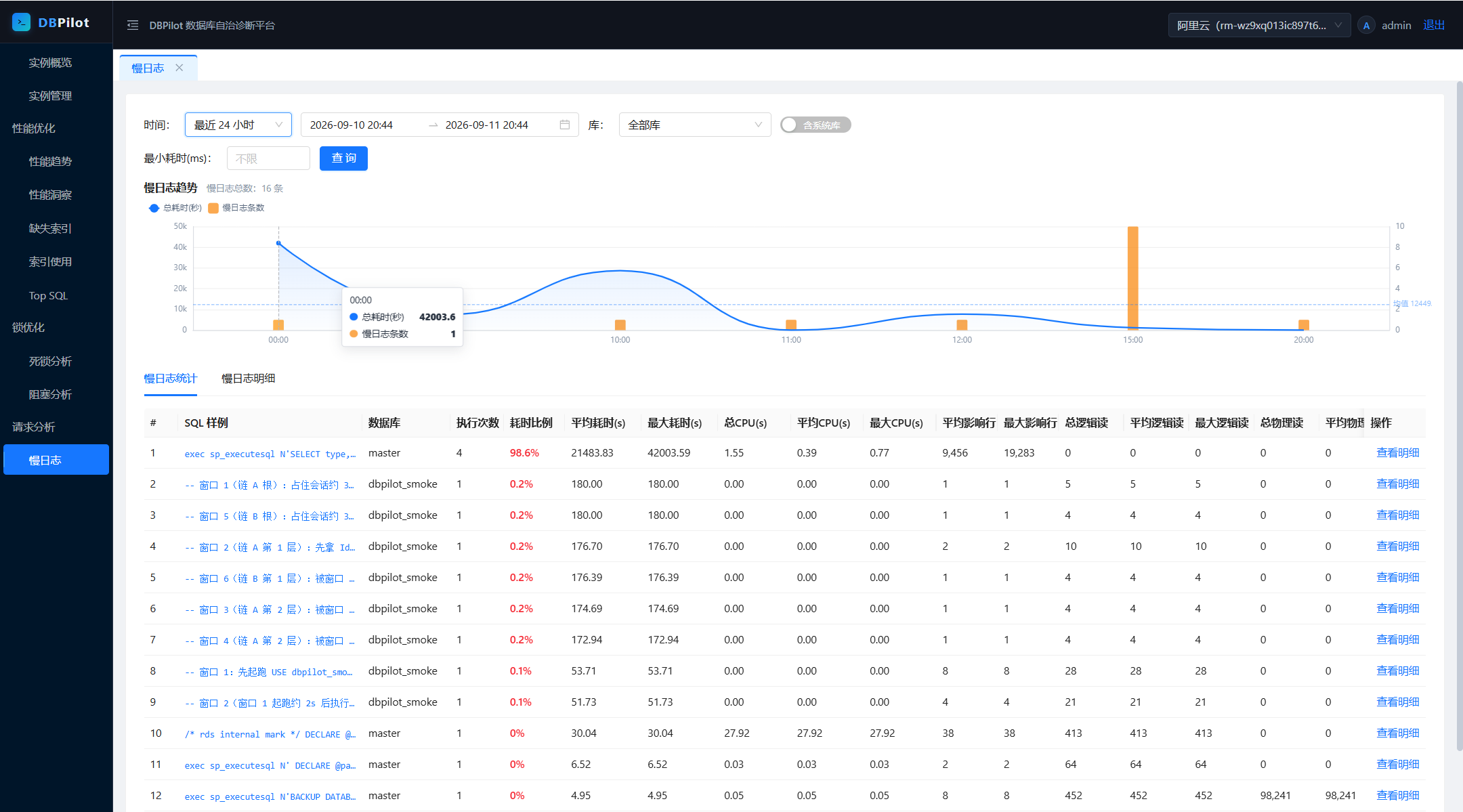 |
Quick start
Fastest path: NuGet packages (frontend embedded — no Node.js). Requires .NET SDK 10.0+.
- Create a host project and add the metapackage:
mkdir dbpilot-demo && cd dbpilot-demo
dotnet new web
dotnet add package DBPilot
Don't name the host project
dbpilotorDBPilot.*— it collides with the NuGet package and restore fails (NU1108).
- Replace
Program.cswith:
using DBPilot.AspNetCore.Extension;
using DBPilot.Core.Providers;

var builder = WebApplication.CreateBuilder(args);
builder.AddDBPilot(o => o.PlatformEngine = DbpilotEngine.Sqlite);  // metadata store: SQLite, zero dependencies

var app = builder.Build();
app.UseDBPilot();
app.Run();
- Replace
appsettings.jsonwith (SQLite flavor):
{
  "Serilog": {
    "MinimumLevel": {
      "Default": "Information",
      "Override": { "Microsoft": "Warning", "System": "Warning" }
    }
  },
  "DBPilot": {
    "ConnectionString": "Data Source=dbpilot_platform.db",
    "Mcp": { "ApiKey": "<random key; non-empty enables MCP, empty = off>" },
    "Auth": {
      "Username": "admin",
      "PasswordHash": "pbkdf2$100000$IOaBWezPYRnzEbBWYwLxZA==$xBWm8jjDfanDmyRttfnZoG4MIk8lcF0UnDbpjJuWaEU=",
      "Secret": "<your master key (>= 32-char random string)>"
    }
  },
  "AllowedHosts": "*"
}
ConnectionStringandAuth:Secretare required — the SQLite file and schema are created on startup; the master key is generated as shown below.PasswordHashis the hash of the default passworddbpilot@2026; keep it to log in with the default.
- Run:
dotnet run # → http://localhost:5000
- Log in with
admin/dbpilot@2026(change it after deployment), then register your first instance: Instances → Add → Test connection → Enable. Real-time pages work immediately; history accumulates.
Metadata store: for SQL Server / MySQL / PostgreSQL, switch PlatformEngine and the connection string — that's all; registered instances are unaffected. SQLite suits evaluation and single-machine use; prefer a server engine for production (and multi-process roles). Ready-made hosts: samples/ (SqlServer :5200 / MySql :5201 / Sqlite :5203 / PostgreSql :5204).
Password and master key
Change the login password: passwords are PBKDF2 hashes in DBPilot:Auth:PasswordHash — replace the hash to change the password.
- Create a two-line
hash.csoutside any project directory (your home dir works). Inside a project,dotnet runwould treat it as an argument:
#:package DBPilot.Core@0.5.3
Console.WriteLine(DBPilot.Core.Auth.PasswordHasher.Hash(args[0]));
- Run it — the whole output line is the new hash:
dotnet run hash.cs <new-password>
- Paste it into
DBPilot:Auth:PasswordHash, restart.
Repo clones can skip the steps: dotnet run --project samples/DBPilot.Sample.SqlServer -- --hash <new-password>.
Master key (Auth:Secret, or env DBPILOT_MASTER_KEY) — required, exactly two uses:
| Purpose | What it does | If you change it |
|---|---|---|
| Login-cookie signing | issues/validates login tickets (HMAC-SHA256) | all sessions logged out; log in again |
| Instance-credential encryption | instance passwords stored AES-256-GCM-encrypted in the metadata DB | old ciphertext is undecryptable, no recovery — re-enter each instance's password in the UI |
Hence startup fails without it, and you should not change it once in use. Generate one:
openssl rand -base64 32      # Linux / macOS / Git Bash
# PowerShell: [guid]::NewGuid().ToString("N") + [guid]::NewGuid().ToString("N")
Configuration (appsettings.json)
Two required keys + one required value — DBPilot:ConnectionString, DBPilot:PlatformEngine, and a master key (Auth:Secret or env DBPILOT_MASTER_KEY). Missing → startup error; everything else is optional with defaults.
| Key | Required | Notes |
|---|---|---|
DBPilot:ConnectionString |
yes | metadata DB connection string; schema auto-created on startup |
DBPilot:PlatformEngine |
yes | sqlserver / mysql / postgresql / sqlite; in code: o.PlatformEngine = DbpilotEngine.SqlServer. Independent of which engines you monitor |
DBPilot:Auth:Secret |
yes (or env) | master key — signs login cookies, encrypts instance credentials; ≥32-char random string |
DBPILOT_MASTER_KEY (env) |
yes (or Secret) | env form of the master key, container-friendly; config value takes precedence |
DBPilot:Auth:Username / PasswordHash |
no | login account (default admin) / password hash (default dbpilot@2026) |
DBPilot:Mcp:ApiKey |
no | MCP Server switch (non-empty = on) |
DBPilot:Roles |
no | process roles (Web / Collector, both by default); multi-process = 1 collector + N web fronts — two collectors on one metadata DB double-collect |
DBPilot:Jobs |
no | per-collector switch & cron; empty value = disable that collector |
DBPilot:Retention / DBPilot:Collect |
no | retention days (auto-clean) / parallelism & backoff |
DBPilot:AutoInitSchema |
no | auto-create schema on startup (default true; set false when DBAs own the schema) |
DBPilot:TopSqlExcludePatterns |
no | Top SQL noise filter (LIKE patterns); default set built in, explicit empty array clears it |
Monitored instances are never configured here — they live in the UI, credentials encrypted in the metadata DB.
Building from source
Additionally requires Node.js 20+ (the embedded web UI comes from the frontend build; NuGet packages ship it prebuilt).
git clone https://github.com/SkyChenSky/DBPilot.git
cd DBPilot
scripts\run\setup.bat      # frontend build + compile + sample appsettings.json (default SqlServer host; pass MySql / Sqlite / PostgreSql to switch)
# edit samples/DBPilot.Sample.SqlServer/appsettings.json — fill in the connection string and Auth:Secret
dotnet run --project samples/DBPilot.Sample.SqlServer    # → http://localhost:5200
Non-Windows / manual equivalent:
cd web && npm install && npm run build
cd .. && dotnet build
cp samples/DBPilot.Sample.SqlServer/appsettings.template.json samples/DBPilot.Sample.SqlServer/appsettings.json
Day-to-day dev: scripts\run\dev.bat, or two terminals — dotnet watch --project samples/DBPilot.Sample.SqlServer (backend, Swagger at /swagger) + cd web && npm run dev (frontend → http://localhost:5173). Tests: `scrip