eda-agent
by salitronic
Open-source MCP server that lets an AI drive a live session of Altium Designer, and optionally KiCad or EasyEDA Pro, editing the open design in place while you watch. 300+ tools: schematic, PCB, library and project automation, design review, audits, rendering, auto-placement, panelization, autonomous design-plan executor. Apache-2.0.
213stars
40forks
Python
Added 9/21/2026
⚠️ Third-Party Software Notice
This skill is third-party open-source software developed and hosted independently on GitHub. SkillsLLM is an informational directory and does not control or maintain the underlying repository.
Any security checks, ratings, or warnings displayed by SkillsLLM are automated and limited in scope. They do not constitute a security certification or guarantee that the software is safe, error-free, or free from malicious code, vulnerabilities, compromised dependencies, or prompt-injection risks.
Review the source code, permissions, dependencies, and configuration before installing or running any third-party skill. Use is at your own risk. To the maximum extent permitted by applicable law, SkillsLLM is not liable for losses arising from third-party software.
AI Agentsaiai-agentaltiumaltium-designerclaudeclaude-codedelphiscriptdesign-reviewdrceasyedaedaelectronic-design-automationhardware-designkicadkicad-pcbmcpmodel-context-protocolpcbpcb-designschematic
Installation
# Add to your Claude Code skills
git clone https://github.com/salitronic/eda-agent
Getting Started
Guides for using ai agents skills like eda-agent.
- Caveman: Cut Claude Token Use by 65%How agent-side prompt compression works, when to use it, and when not to.
- What is an AI Skills Marketplace?Definitions, how marketplaces work, and how to choose between them in 2026.
- Getting Started with AI SkillsFirst-time install walkthrough for Claude Code, Codex CLI, and ChatGPT.
Security ReportVerified
Last scanned: 9/21/2026
{
  "issues": [],
  "status": "PASSED",
  "scannedAt": "2026-09-21T09:37:41.862Z",
  "npmAuditRan": true,
  "pipAuditRan": true,
  "promptInjectionRan": true
}
Compare with similar skills
See how eda-agent compares with popular alternatives.
eda-agent
MCP server that lets an AI (or any MCP-compatible client) interact with a live Altium Designer session, with KiCad and EasyEDA Pro available as additional backends. It exposes around 400 tools on Altium, covering schematic, PCB, library, project, and design-agent operations, over a persistent DelphiScript bridge. The AI reads the design you currently have open, asks questions about it, and can modify it in place while you watch. The backend is selected at startup, so each user sees only their own tool set.
⚠️ Experimental. Not all tools are extensively tested. Some can crash the Altium DelphiScript engine. See Known limitations before using on any design you haven't backed up.
Demo
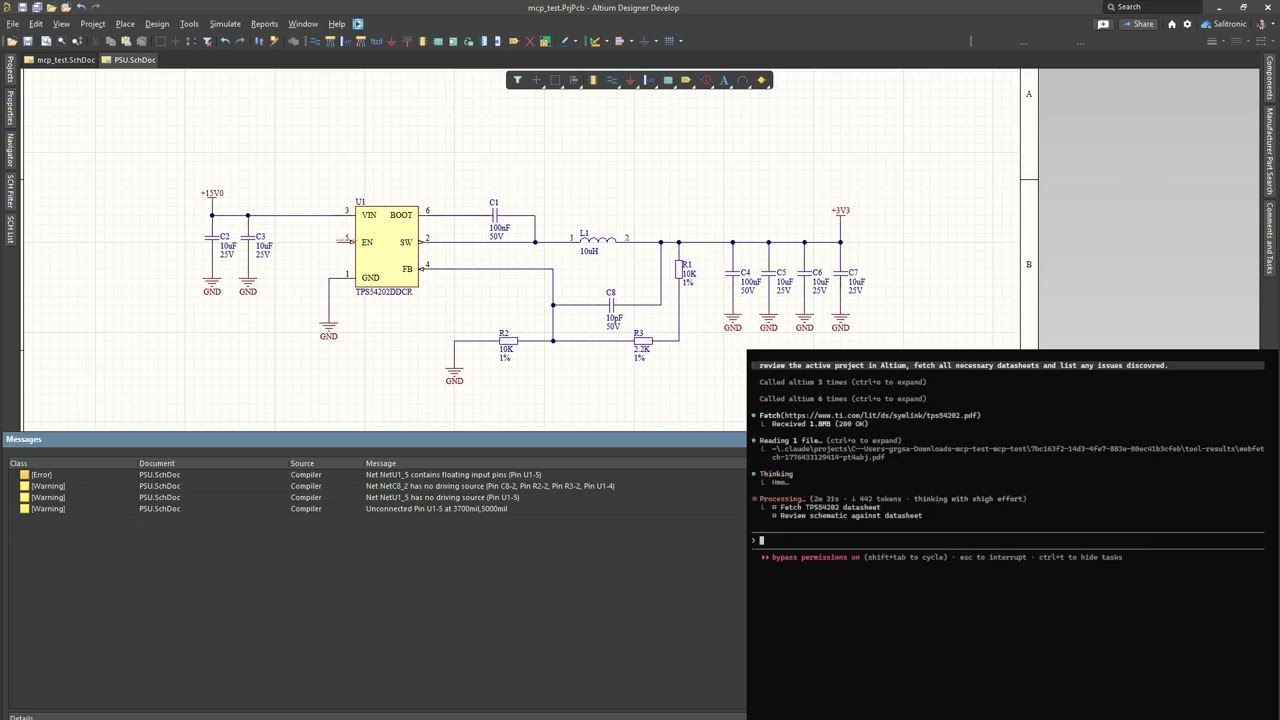
Claude Code reviewing a buck converter through eda-agent. The feedback resistor divider on this schematic is intentionally wrong; Claude catches it among other recommendations.
Dashboard
Two dashboards ship with eda-agent:
- In-Altium status window - a floating Altium-side window showing live status, request count, cumulative Altium-side time, auto-shutdown countdown, and a per-command log with durations.
Hide pingsfilters the 30 s keep-alive traffic;Only >100msisolates slow calls. The Detach button saves all dirty docs and exits the polling loop cleanly. - Web dashboard - a local browser dashboard at
http://127.0.0.1:8766, focused on design review. A Review tab surfaces datasheet / MPN / manufacturer / footprint coverage gauges and an actionable issue queue (missing datasheet, missing MPN, orphan nets, ...); Project, Components, Nets, Libraries and Plan tabs give live structured views. Click any component or net to drill into a detail drawer; one click cross-probes it into Altium. Light / dark theme, server-sent-events live feed. It is auto-started by the MCP server - the Open Dashboard button on the in-Altium status window launches the browser.
How it works
- Altium Designer stays open and in full control of your design
- A DelphiScript polling loop runs inside Altium's scripting engine
eda-agent(Python, launched by your MCP client) sends commands via file-based IPC- Altium executes, writes a response, and returns to polling
- You see the changes happen live in Altium
This is not a batch tool that opens a project, runs a script, and exits. It's a live connection for as long as you want it (conversational design review, guided refactoring, ad-hoc BOM queries, "what nets does this resistor connect to?"), all on the project you currently have open.
Features
- ~400 tools on the default Altium backend (480+ with both registered) across application, project, library, schematic/general, PCB, and design-agent categories
- Generic primitives (
obj_query,obj_modify,obj_create,obj_delete,run_process) that work on almost any schematic or PCB object type via late-binding, avoiding per-type handler proliferation - Bulk batch primitives:
obj_batch_modify,obj_batch_create,obj_batch_delete,pcb_place_tracks,pcb_move_components,sch_place_wires,place_net_labels,place_power_ports,sch_place_components,sch_set_components_parameters,get_sch_doc_pins,lib_add_pins,proj_get_connectivity_many,sim_attach_primitives. Collapse N LLM turns + N IPC round-trips into one. Typical wall-time savings: 10 to 100x on multi-item edits - Design review snapshot:
design_review_snapshotbundles 8 to 12 review reads (project info, components, nets, rules, diff, messages, stats, unrouted, BOM) into a single call. One LLM turn instead of a dozen - Design-lint sweep:
design_lint_reportruns 31 audit checks in one IPC pass and returns a structured violation list - schematic-side (component-parameter visibility per class, power-port orientation, floating ports, multi-output / no-driver nets, duplicate designators, off-grid components) and PCB-side (DNP variant components, tented-via ratio, near-miss track endpoints, signal vias without nearby return via, via antennas, removed pad shapes, components outside outline, pads too close to board edge, invalid polygon regions, optional DRC). Each check is also exposed as a standaloneaudit_*MCP tool; the dashboard's Status → Health subtab has a one-click Lint panel that calls/api/lintand groups results by Schematic / PCB - Canonical circuit blocks:
design_add_circuit_blockfolds a whole block into aDesignPlanin one call, allocating refdes, wiring every pin to the right net and tagging power / ground and roles. Twelve of them:decoupling,pullup,pulldown,series_resistor,voltage_divider,rc_lowpass,rc_highpass,led_indicator,crystal,pi_filter,mosfet_low_side,mosfet_high_side. Naming-agnostic: you supply the part identities, it owns only the wiring pattern.design_list_circuit_blocksreturns each one's parameter contract, so the planner never guesses a parameter name - Datasheet-first discipline: every component-surfacing response (
pcb_get_components,proj_get_bom,proj_get_component_info,proj_find_component,lib_search,design_review_snapshot,sim_get_readiness) carries a_datasheet_guidanceblock with per-part vendor search queries.app_attach/app_pingcarry a_system_reminderso every MCP client that connects sees the rule at session start. LLM-fabricated datasheet values are forbidden; WebFetch/WebSearch are called out by name - Sch <-> PCB netlist crossref:
crossref_net(net_name)compares the schematic pin list against the PCB pad list for the same net. Catches ECO drift, stale post-fabrication routing, phantom nets from port/sheet-entry rename conflicts.in_syncflag +sch_only/pcb_onlydiff - SPICE simulation workflow:
sim_get_readinessaudits every component and partitions into ready / needs-primitive / needs-file.sim_attach_primitivessets SpicePrefix + Value on passives.sim_attach_modellinks a vendor.mdl/.ckt.sim_rundispatches the simulator. Built-in guardrail: never fabricate a SPICE model file, fetch the vendor one - Focus-independent PCB access: every PCB handler falls back to
GetPCBBoardByPathwhenGetCurrentPCBBoardreturns nil (user has a sch tab focused). No more misleading "No PCB document is active" when the PCB is right there - Fast and compile-cached: persistent polling loop; ~10 ms per call in active mode.
SmartCompilecachesDM_Compilewith a 2 s TTL so a multi-read review pays for one compile instead of a dozen. Explicitproj_force_recompile+proj_get_compile_freshnessprobes for cases that need a guaranteed-fresh netlist (e.g. after user edits) - Persistent polling loop: one script start, then ~10 ms per tool call in active mode
- Annotation runs silently:
proj_annotatedesignates components without popping the annotate dialog - Drives the GUI where there is no API: a great deal of Altium exists only as menus and dialogs.
app_click_menuwalks the real menu bar by name (and lists what a menu holds, so paths are discovered rather than guessed);app_list_open_dialogsreports what is on screen, what it says and whether Altium is stuck;app_set_dialog_controlsets checkboxes, fields and grid rows;app_press_dialog_buttonpresses one button;app_drive_dialogsanswers a whole sequence reactively. None of it uses the bridge, only Win32 and the accessible layer, so it keeps working while a modal has the scripting engine blocked, which is exactly when you need it.app_run_ui_commandfires a menu command and answers its dialogs in the same call, because a command that opens a modal blocks the bridge and a second call would never arrive. The driver decides from what is on screen rather than from a script, stops on any dialog it cannot classify, and gates the press that changes the design behindallow_commit. Dialog text that Altium paints into handle-less controls is recovered by OCR and labelled as read from pixels, not text - Deferred save for speed: mutations mark documents as modified in memory; disk writes happen on explicit
app_save_all(or automatically onapp_detach). Before this, every edit triggered a full project save, which dominated latency - Two dashboards: an in-Altium floating status window (status, request count, per-command performance, command log, Detach button) and a browser-based web dashboard (
127.0.0.1:8766) for design review - datasheet / MPN / footprint coverage gauges, an actionable issue queue, component / net drill-in, one-click cross-probe into Altium, light / dark theme. The whole project view loads in one bundled IPC round-trip (project.dashboard_snapshot); the web dashboard auto-starts with the MCP server - DelphiScript trap linter:
scripts/altium/lint.py(wired intobuild.py) scans the Pascal sources for known parser hazards -Cardinal()casts, malformed hex literals, empty.Add('')arguments, braces inside comments, fixed-size arrays as function locals, reserved-word identifiers - and fails the build before a bad deploy - Activity logs: every command is appended to
workspace/activity.log(CSV with timestamps, durations, command name, response size). The bridge also writesbridge_trace.logfor IPC-level diagnostics - Bulk-tool nudge: when a singular tool is hit 2 to 3 times in 10 s, the response carries a
_hint_bulkfield pointing at the batch variant. Clients that missed the bulk tool in the docstring learn about it at runtime - Design agent surface: six MCP tools (
design_get_discipline,design_snapshot_inventory,design_validate_plan,design_execute_plan,design_audit_schematic,design_validate) that let an
Frequently Asked Questions
What is eda-agent?
eda-agent is an open-source ai agents skill for AI coding assistants such as Claude Code, Codex CLI, and ChatGPT, built by salitronic. Open-source MCP server that lets an AI drive a live session of Altium Designer, and optionally KiCad or EasyEDA Pro, editing the open design in place while you watch. 300+ tools: schematic, PCB, library and project automation, design review, audits, rendering, auto-placement, panelization, autonomous design-plan executor. Apache-2.0. It has 213 GitHub stars.
Is eda-agent safe to use?
Yes. eda-agent passed SkillsLLM's automated security scan — a dependency vulnerability audit plus prompt-injection heuristics — with no high-severity issues. You can read the full report in the Security Report section on this page.
How do I install eda-agent?
Clone the repository with "git clone https://github.com/salitronic/eda-agent" and add it to your Claude Code skills directory (see the Installation section above).
What programming language is eda-agent written in?
eda-agent is primarily written in Python. It is open-source under salitronic on GitHub, so you can review or fork the full source.
Are there alternatives to eda-agent?
Yes. SkillsLLM lists many other AI Agents skills you can browse and compare side by side. Open the AI Agents category from the badge at the top of this page, or use the Related Skills and comparison links further down to weigh eda-agent against similar tools.
Comments (0)
to leave a comment.
No comments yet. Be the first to share your thoughts!
Related Skills
The agent harness performance optimization system. Skills, instincts, memory, security, and research-first development for Claude Code, Codex, Opencode, Cursor and beyond.
264,141
39,493
JavaScript
AI Agentsai-agentsanthropic
Skills for Real Engineers. Straight from my .agents directory.
250,518
21,171
Shell
AI Agents
An agentic skills framework & software development methodology that works.
234,966
20,863
Shell
AI Agentsaibrainstorming
Fair-code workflow automation platform with native AI capabilities. Combine visual building with custom code, self-host or cloud, 400+ integrations.
205,516
60,818
TypeScript
MCP Serversaiapis
The agent harness performance optimization system. Skills, instincts, memory, security, and research-first development for Claude Code, Codex, Opencode, Cursor and beyond.
185,940
28,768
JavaScript
AI Agentsai-agentsanthropic