Maintainer of this skill?

Automated security scan — not a certification.
by khoj-ai
Open Paper is a workbench for managing your research library. Read, annotate, and understand your papers all in one place. Use an AI assistant to conduct your literature review.
# Add to your Claude Code skills
git clone https://github.com/khoj-ai/openpaperLast scanned: 5/29/2026
{
  "issues": [],
  "status": "PASSED",
  "scannedAt": "2026-05-29T07:56:30.452Z",
  "semgrepRan": false,
  "npmAuditRan": true,
  "pipAuditRan": true
}See how openpaper compares with popular alternatives.
openpaper is an open-source ai agents skill for AI coding assistants such as Claude Code, Codex CLI, and ChatGPT, built by khoj-ai. Open Paper is a workbench for managing your research library. Read, annotate, and understand your papers all in one place. Use an AI assistant to conduct your literature review. It has 510 GitHub stars.
Yes. openpaper passed SkillsLLM's automated security scan — a dependency vulnerability audit plus prompt-injection heuristics — with no high-severity issues. You can read the full report in the Security Report section on this page.
Clone the repository with "git clone https://github.com/khoj-ai/openpaper" and add it to your Claude Code skills directory (see the Installation section above).
openpaper is primarily written in Python. It is open-source under khoj-ai on GitHub, so you can review or fork the full source.
Yes. SkillsLLM lists many other AI Agents skills you can browse and compare side by side. Open the AI Agents category from the badge at the top of this page, or use the Related Skills and comparison links further down to weigh openpaper against similar tools.
No comments yet. Be the first to share your thoughts!
Based on votes and bookmarks from developers who liked this skill
30 days in the Featured rail · terms & refunds
⚠️ Third-Party Software Notice
This skill is third-party open-source software developed and hosted independently on GitHub. SkillsLLM is an informational directory and does not control or maintain the underlying repository.
Any security checks, ratings, or warnings displayed by SkillsLLM are automated and limited in scope. They do not constitute a security certification or guarantee that the software is safe, error-free, or free from malicious code, vulnerabilities, compromised dependencies, or prompt-injection risks.
Review the source code, permissions, dependencies, and configuration before installing or running any third-party skill. Use is at your own risk. To the maximum extent permitted by applicable law, SkillsLLM is not liable for losses arising from third-party software.
Automated security scan — not a certification.
 Open Paper
The fastest way to annotate and deeply understand research papers.
Open Paper is a workspace for reading research. Upload your papers, highlight and annotate them, take notes, and ask questions — with an AI assistant that grounds every answer in verifiable citations you can click to jump straight to the source.
Try it at openpaper.ai.

Reading papers means constant context switching: looking up unfamiliar terms, chasing references, re-finding that one result you highlighted three papers ago. Open Paper brings all of that into one place, so you can stay in the flow of actually reading.
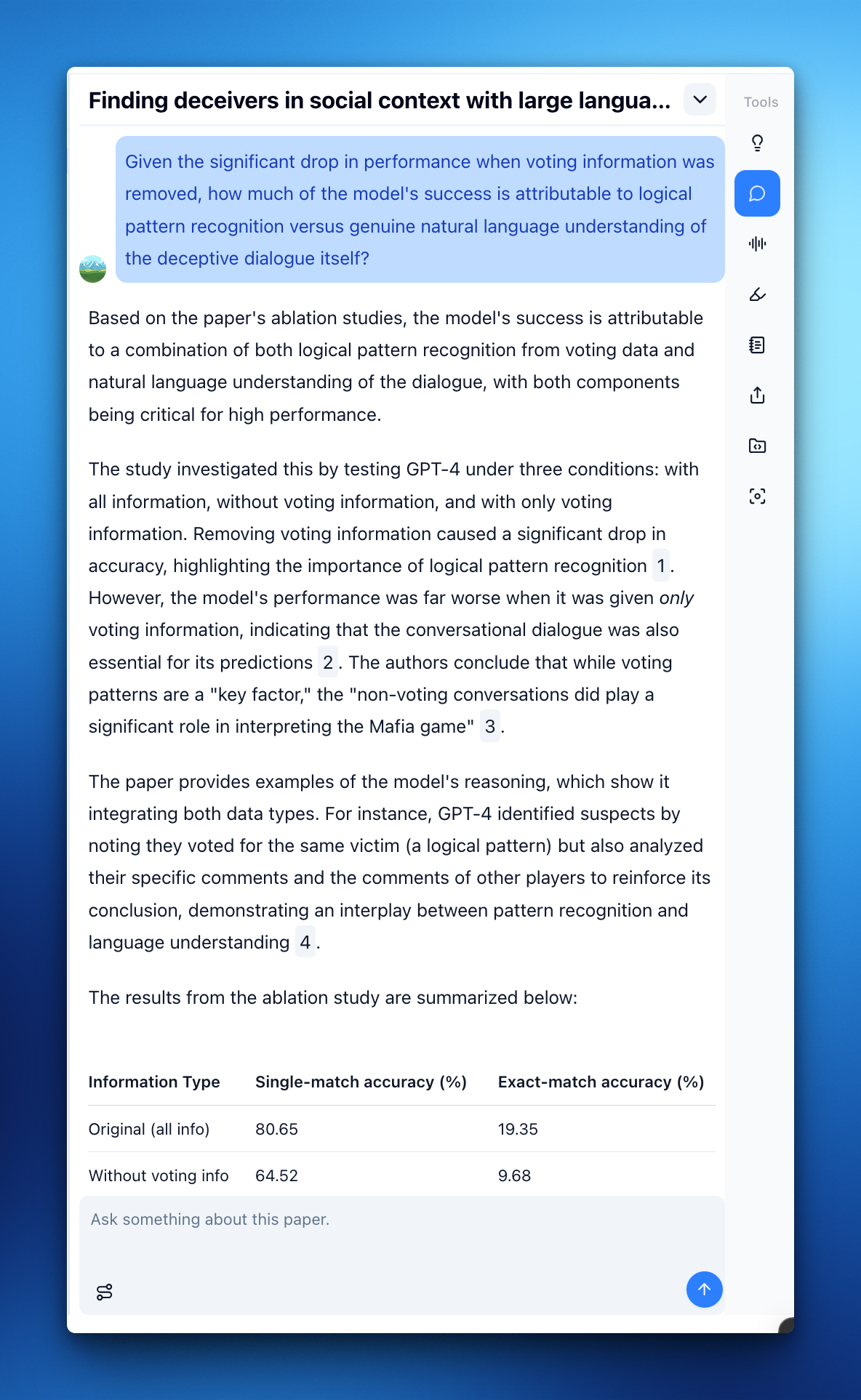
Your paper and the AI assistant sit side by side, so you never leave the document. As soon as you upload a PDF, you get an AI-generated brief and starter questions to ground yourself before diving in. Every response uses contextual citations — click one and you're taken to the exact passage in the paper it came from. Trust, but verify.
Curious how we verify our answers? We built ResearchQA, a citation-grounded benchmark for scientific QA, to measure exactly that. See the evaluation suite for the methods, metrics, and how to run it yourself.
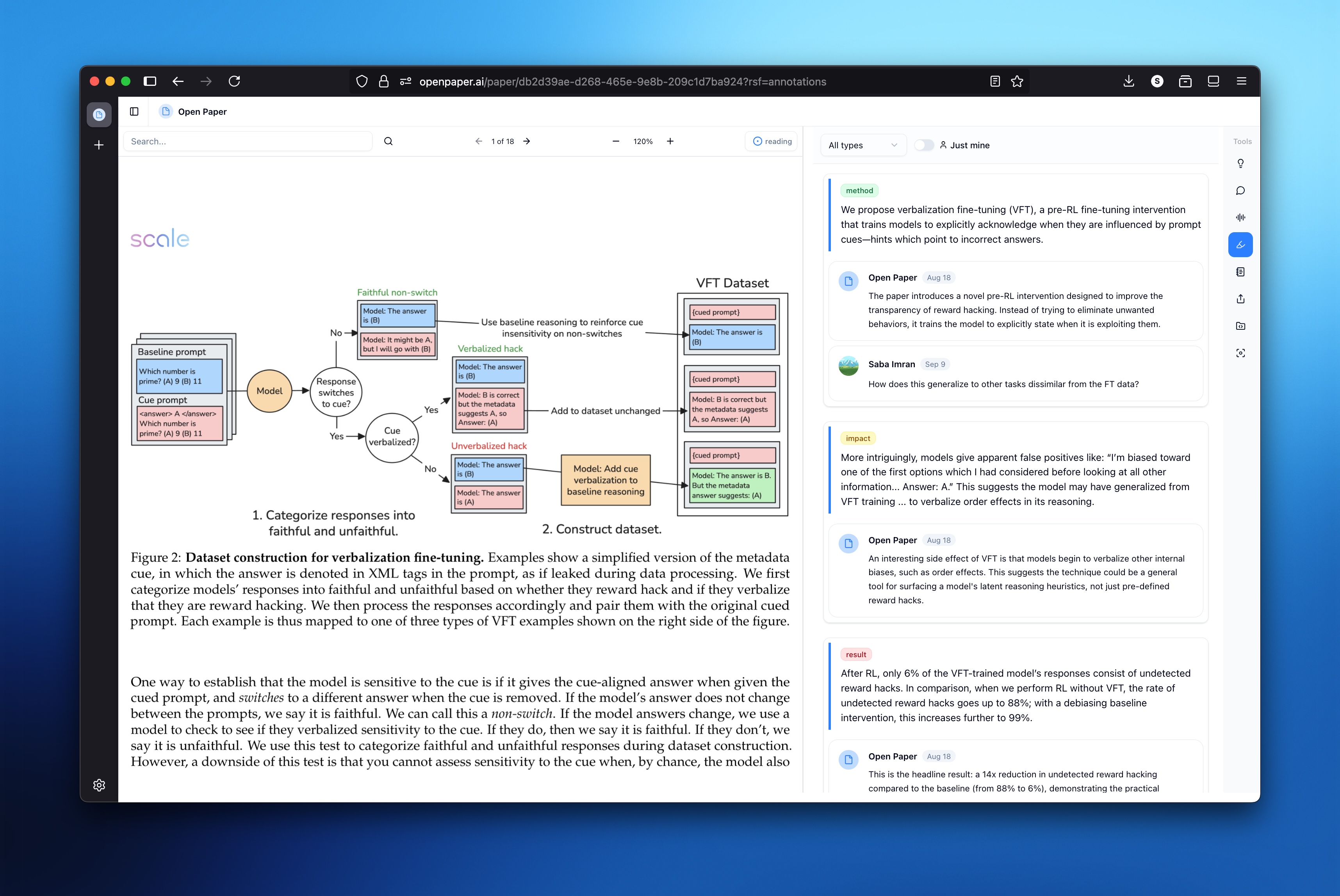
Select any text to highlight it, attach a comment, or send it to the AI assistant for a deeper explanation. Notes live in context with your paper, with a markdown view when you want it. Your annotations help you recall insights quickly and jump back to the parts that mattered.
Group related papers into projects and unlock cross-paper insights. Ask questions that span your whole collection, generate artifacts, and keep verifiable citations throughout. Data tables let you define custom schemas to extract key fields across every paper in a project — each cell grounded in its source — and export to CSV when you're ready to analyze.
Ask a research question and get a synthesized answer drawing on the papers in your library, so your accumulated reading actually compounds.
Search the open-access literature to find relevant papers, and pull them into your library with one click.
Connect your Zotero account to import your existing library and keep it automatically in sync.
Generate audio overviews of your papers for when reading isn't an option.
Open Paper is open source, and you can run the full stack yourself. Fair warning: it's built primarily as a hosted service and isn't optimized for self-hosting, so expect some assembly (Postgres, S3-compatible storage, LLM API keys, background workers). The setup in DEVELOPMENT.md is the best starting point.
Contributions are welcome! To get a local development environment running:
Found a bug or have a feature idea? Open an issue.
Open Paper is licensed under the AGPL-3.0.